Your hiring process isn’t broken. It’s working exactly as designed — and that’s the problem. Here’s what to change.
You’ve invested in diversity training. You’ve updated your careers page with stock photos of smiling, diverse teams. You might even have an ERG for disability inclusion. And yet, your hiring funnel is systematically screening out some of the most capable, creative, and detail-oriented people in the talent market — before they ever reach an interview.
The candidates you’re losing aren’t underqualified. They’re neurodivergent: individuals who are autistic, ADHD, dyslexic, dyspraxic, Tourettic and otherwise neurologically different people whose neurotypes shape how they process information, communicate and work. And the standard recruitment playbook, from the way job ads are written to the way interviews are conducted, was never designed with them in mind.
This isn’t a niche concern. Neurodivergent people represent an estimated 15–20% of the global population. Yet their participation in the workforce tells a vastly different story.
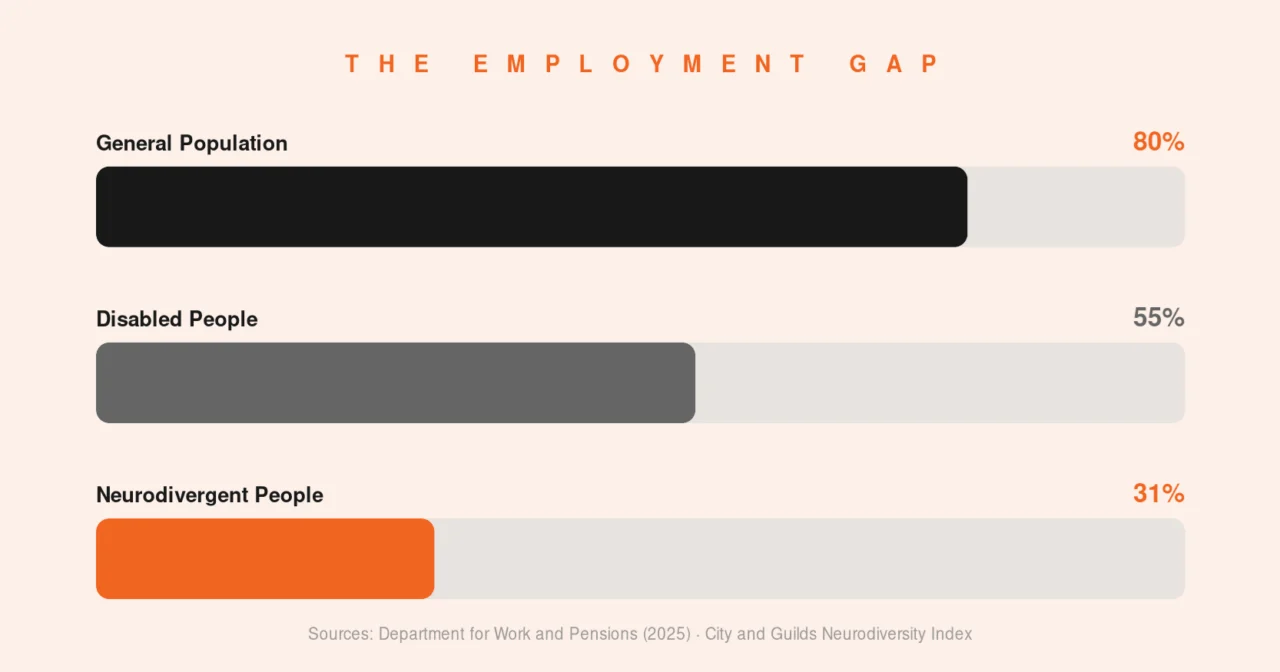
These aren’t numbers that reflect a lack of talent. They reflect a hiring infrastructure that confuses social fluency with competence, speed with capability, and conformity with culture fit. They reflect a system with filters — and those filters have a bias baked in.
Let’s look at five of the most common recruitment practices that are quietly eliminating neurodivergent candidates, and what forward-thinking organisations are doing instead.
1 THE FILTER
Jargon-Heavy, Ambiguous Job Descriptions
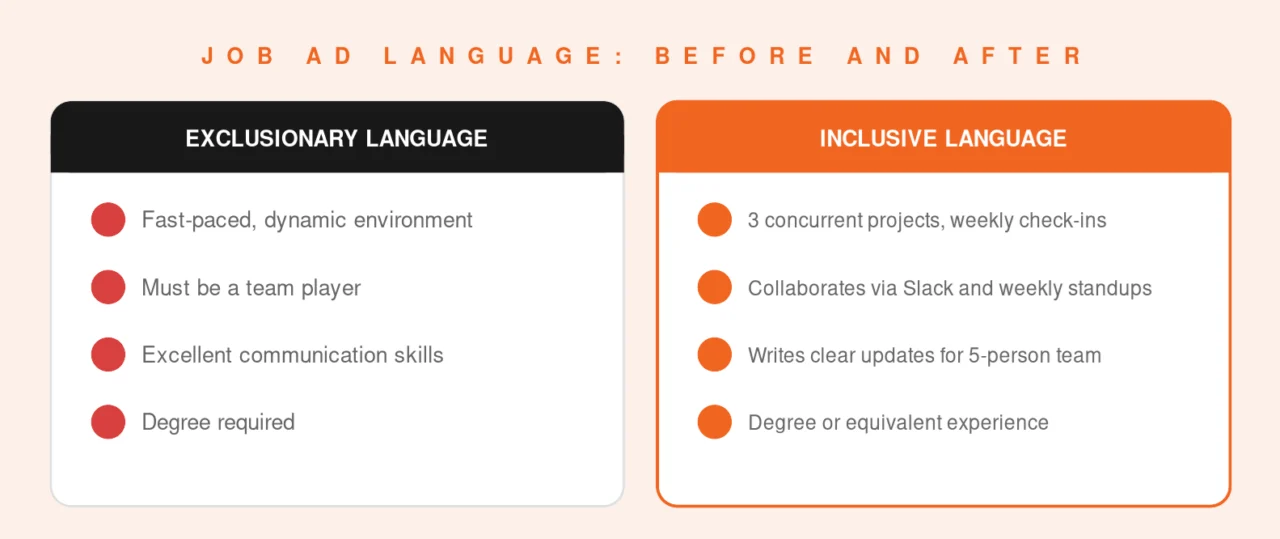
Consider a job ad that reads: “We’re looking for a self-starting team player who thrives in a fast-paced, dynamic environment and can juggle multiple priorities with minimal direction.” What does this actually mean? For most neurodivergent candidates, it means: proceed with caution — or don’t proceed at all.
Vague phrases like “dynamic environment,” “wear many hats,” and “strong interpersonal skills required” create ambiguity that disproportionately deters autistic applicants, who tend to interpret language literally. ADHD candidates may struggle to determine whether the role genuinely requires constant multitasking or simply uses it as corporate shorthand. Dyslexic applicants may be discouraged by dense, text-heavy postings with poor visual hierarchy.
Research from the Indeed Hiring Lab shows that while neurodiversity-inclusive job postings have risen from 0.5% to 1.3% of all US listings between 2018 and 2024, the overwhelming majority of postings still rely on language patterns that signal exclusion — even when the employer intends the opposite.
THE FIX
Write job ads like technical specifications, not marketing copy. State the actual tasks the person will do, the tools they’ll use, and the outcomes they’re responsible for. Replace “strong communication skills” with “writes clear project updates for a team of five.” Replace “fast-paced environment” with “typical workload includes three concurrent projects with weekly deadlines.” Remove requirements that aren’t genuinely essential — especially “required” degree qualifications that the role doesn’t actually need.
2 THE FILTER
Timed Assessments and Speed-Based Screening
Online assessments with countdown timers are one of the most widely used screening tools in modern recruitment. They’re efficient for employers. They’re also one of the fastest ways to lose neurodivergent talent.
For candidates with ADHD, timed conditions can trigger anxiety that overwhelms executive function — the very cognitive processes the test claims to measure. For dyslexic candidates, reading-heavy assessments under time pressure don’t test analytical ability; they test reading speed. Autistic candidates may need additional processing time not because they lack understanding, but because they process information more deeply and methodically.
Only 21% of neurodivergent jobseekers report feeling able to demonstrate their true abilities during standard assessments and interviews. That means nearly 80% of your neurodivergent applicant pool is being evaluated on a distorted picture of their capabilities.
THE FIX
Remove or extend time limits on pre-hire assessments. Offer candidates the choice between timed and untimed formats — or replace timed tests entirely with work-sample tasks that mirror actual job responsibilities. If you must use assessments, provide the questions in advance so candidates can demonstrate knowledge rather than speed. Consider offering multiple assessment formats (written, verbal, practical demonstration) to let different cognitive styles shine.
“When we removed timed constraints from our technical assessments, we didn’t just get more neurodivergent applicants — we got better data on all applicants.”
— HR Director, Australian Technology Company
3 THE FILTER
Unstructured, “Culture Fit” Interviews
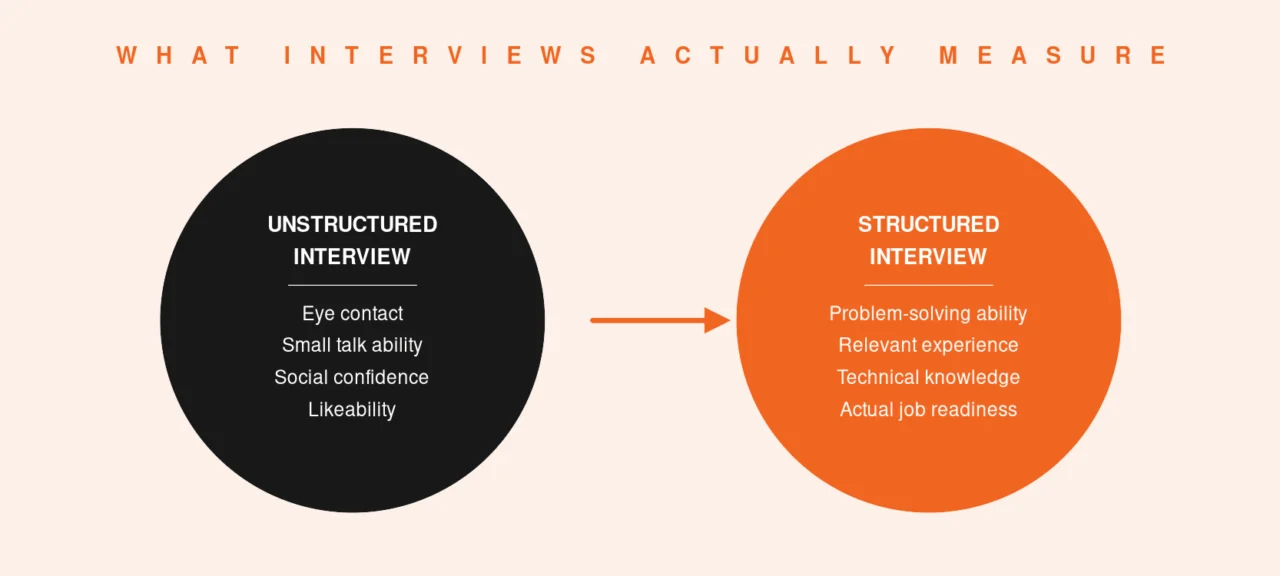
The unstructured interview — where a hiring manager sits down and has a “casual chat” to see if someone is “a good fit” — remains the dominant interview format across industries. It’s also one of the least predictive and most biased assessment methods in organisational psychology.
For neurodivergent candidates, unstructured interviews are a minefield. Autistic applicants may not make typical eye contact, may take questions literally, or may not intuitively know when to offer personal anecdotes versus technical responses. Candidates with ADHD may ramble under conversational pressure, or conversely, go blank. Those with social anxiety — common across many neurodivergent profiles — may present as disengaged or lacking confidence.
The core problem: unstructured interviews test social performance, not job performance. “Culture fit” often becomes code for “communicates and socialises like the majority of the existing team.” That’s not a hiring strategy — it’s homogeneity maintenance.
THE FIX
Switch to structured interviews where every candidate is asked the same questions, scored against the same rubric. Send interview questions to candidates at least 24 hours in advance — this doesn’t reduce validity; it increases it by removing the advantage of quick verbal processing and letting candidates prepare thoughtful answers. Offer the option of written responses, walking interviews, or asynchronous video submissions. And train interviewers to evaluate answers based on content, not delivery.
4 THE FILTER
Sensory-Hostile Interview Environments
Open-plan offices with fluorescent lighting, a shared hot desk for the day, a panel of five strangers in a glass-walled meeting room — these are everyday features of modern workplaces. For many neurodivergent people, they’re also sources of significant sensory distress.
Sensory processing differences are common across the neurodivergent spectrum. Bright or flickering lights, background noise, strong smells, and the general unpredictability of an unfamiliar physical space can drain cognitive resources before a candidate even begins answering questions. For autistic candidates in particular, sensory overload can trigger shutdowns — a state that looks like disengagement but is actually the nervous system’s protective response to overwhelming stimuli.
When a candidate appears “flat,” “distracted,” or “not fully present” in an interview, the explanation may have nothing to do with their interest or capability. It may have everything to do with the environment you chose.
THE FIX
Ask candidates about their environmental preferences in advance — and act on the answers. Offer remote interview options as a genuine alternative, not a consolation prize. Provide a detailed “what to expect” guide before any on-site visit: layout of the building, where to park, who they’ll meet, what the room looks like, even what the noise level is. Small adjustments — a quiet room, natural lighting, a glass of water — cost virtually nothing but signal to neurodivergent candidates that they’re expected and welcome.
5 THE FILTER
One-Size-Fits-All Application Processes
Most organisations have a single, rigid pipeline: submit a CV and cover letter through an ATS, complete an online assessment, attend a phone screen, pass a panel interview, perhaps complete a group exercise. Every candidate, regardless of how they process information, communicate, or demonstrate competence, is funnelled through the identical sequence.
This isn’t meritocratic. It’s arbitrary. A group exercise tests whether someone can perform under social pressure in a room full of strangers — a skill that has zero relevance for a data analyst role. A phone screen with no visual cues disadvantages candidates who rely on visual information to process conversation. A cover letter tests writing fluency and self-promotion ability, not whether someone can do the job.
The assumption underpinning one-size-fits-all hiring is that uniformity equals fairness. But equity isn’t about treating everyone the same. It’s about ensuring everyone has an equivalent opportunity to demonstrate what they can actually do.
THE FIX
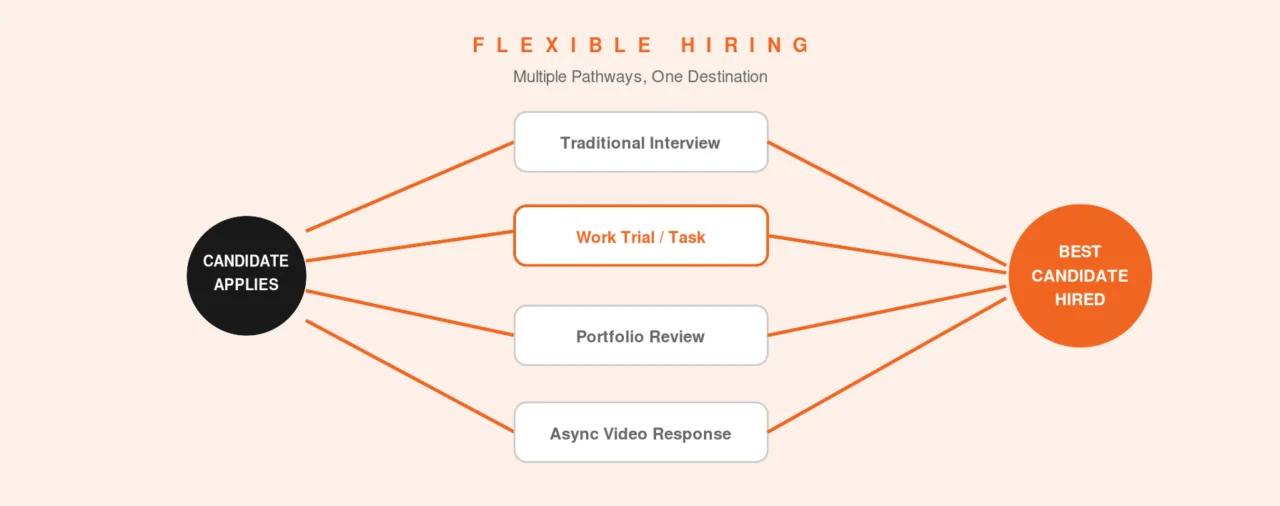
Design multiple pathways into the same role. Let candidates choose between a traditional interview, a work trial, a portfolio review, or a practical task. Provide clear process documentation up front so candidates know exactly what will happen at each stage — neurodivergent or not, nobody performs at their best when they’re navigating ambiguity and anxiety simultaneously. Build flexibility into the process by default, rather than forcing candidates to request accommodations that require them to disclose a diagnosis.
This Isn’t About Charity. It’s About Competitive Advantage.
If this article has read like a critique so far, it’s because the current state of recruitment deserves one. But the case for neuro-inclusive hiring isn’t built on guilt — it’s built on evidence.
Organisations like SAP, Microsoft, and JPMorgan Chase have developed dedicated neurodiversity hiring programmes, and the results consistently show that neurodivergent employees bring distinctive strengths: pattern recognition, sustained concentration, lateral thinking, and meticulous attention to detail.
According to a 2025 systematic literature review published in the Journal of Autism and Developmental Disorders, the key barriers to neurodivergent employment aren’t cognitive limitations — they’re environmental and procedural: exclusionary recruitment processes, inadequate accommodations, and the exhausting burden of masking neurological differences to fit a neurotypical mould.
Remove the barriers, and you access a talent pool that your competitors are systematically ignoring.
|
51% |
of employers have not adapted their recruitment processes to accommodate neurodivergent candidates — despite the proven business case for inclusive hiring. |
Where to Start: A Practical Checklist
Overhauling your entire recruitment infrastructure overnight isn’t realistic. But meaningful change doesn’t require a full rebuild. It requires examining where your current process assumes neurotypicality — and making deliberate choices to offer alternatives.
Audit your job descriptions for jargon and ambiguity. Remove unnecessary requirements. Provide questions in advance. Offer multiple assessment and interview formats. Ask candidates what they need, and believe them when they tell you. Train your hiring managers to evaluate for capability, not conformity. Treat flexibility as a default, not a special request.
Each of these changes costs far less than the ongoing expense of a talent pipeline that filters out 15–20% of the population before they ever get the chance to show you what they can do.
|
Ready to Build a Neuro-Inclusive Hiring Process? Xceptional Academy helps organisations across Australia redesign their recruitment practices to attract and retain neurodivergent talent. |
SOURCES & FURTHER READING
Department for Work and Pensions, UK (2025) · City & Guilds Neurodiversity Index (2025) · Indeed Hiring Lab: Neurodiversity-Inclusive Postings Report (2025) · Journal of Autism and Developmental Disorders: Systematic Literature Review on Facilitators and Barriers to Employment (2025) · World Economic Forum: The Invisible Workforce (2026) · PMC/National Library of Medicine: Access to Employment — Autistic, Neurodivergent and Neurotypical Hiring Experiences (2023)