Most organisations that want to become neuro-inclusive start in the same place: an awareness webinar, an inclusion working party and maybe a Slack channel. These are worthwhile first steps. But if you stop there, you’ll miss the single biggest lever for real change — your people managers.
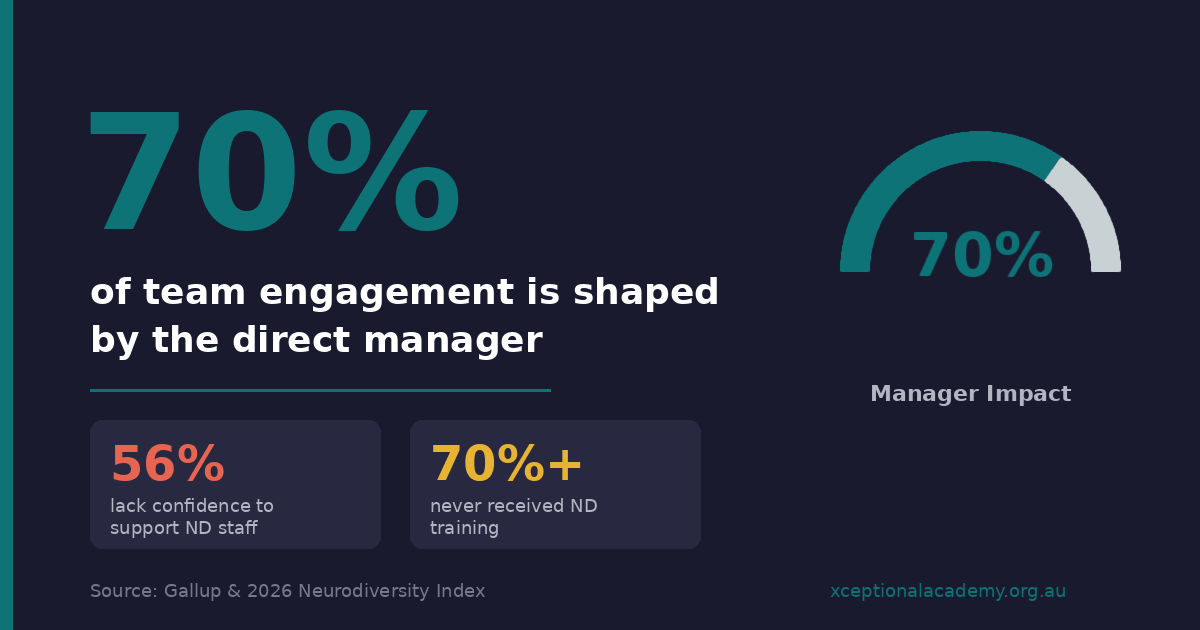
Research from Gallup consistently shows that the manager accounts for roughly 70% of the variance in team engagement. When it comes to neurodivergent employees — people with autism, ADHD, dyslexia, dyspraxia, and other neurological differences — that influence is even more pronounced. A manager who understands how to flex their communication, set clear expectations, and create psychological safety can be the difference between a neurodivergent team member thriving, quietly disengaging or struggling.
And yet, the data tells us most managers are not equipped for this. The 2026 Neurodiversity Index found that 56% of managers lack the confidence to support neurodivergent colleagues, and over 70% have never received any neurodiversity-specific training. That’s a staggering gap between intention and capability.
Why Managers Matter More Than Policy
Think about what a neurodivergent employee actually experiences day to day. They don’t interact with the company DEI strategy. They interact with their manager. The manager decides how work is assigned, how feedback is delivered, whether flexibility is granted, and how performance is measured. Every one of those touchpoints is an opportunity to either include or inadvertently exclude.
Consider a team member with ADHD who does their best deep work between 8am and 11am. A manager who insists on a 9am daily stand-up is, without meaning to, designing a workday that works against that person’s cognitive rhythm. A manager who understands this can make a small scheduling adjustment that unlocks significantly better output — for no additional cost.
Or consider an autistic employee who prefers written instructions to verbal ones. A manager who consistently gives directions in passing conversations — and then wonders why tasks are incomplete — isn’t dealing with a performance problem. They’re dealing with a communication mismatch they have the power to fix.
The Confidence Gap Is the Real Barrier
Here’s the thing: most managers want to do the right thing. The issue isn’t resistance — it’s uncertainty. They worry about saying something wrong, making assumptions about a diagnosis, or singling someone out. So they default to treating everyone identically, which sounds fair but actually ignores the adjustments that would let neurodivergent team members perform at their best.
This confidence gap has measurable consequences. The 2026 Neurodiversity Index reports that neurodiversity-related employment claims have risen 164% over the past four years. Many of these claims stem not from overt discrimination but from a failure to make reasonable adjustments — the kind of adjustments a trained, confident manager would know how to provide.
What Neuro-Inclusive Management Actually Looks Like
Neuro-inclusive management is not about becoming a therapist or memorising diagnostic criteria. It’s about building a small set of leadership habits that benefit the entire team — not just neurodivergent members. Here are the practices that make the biggest difference:
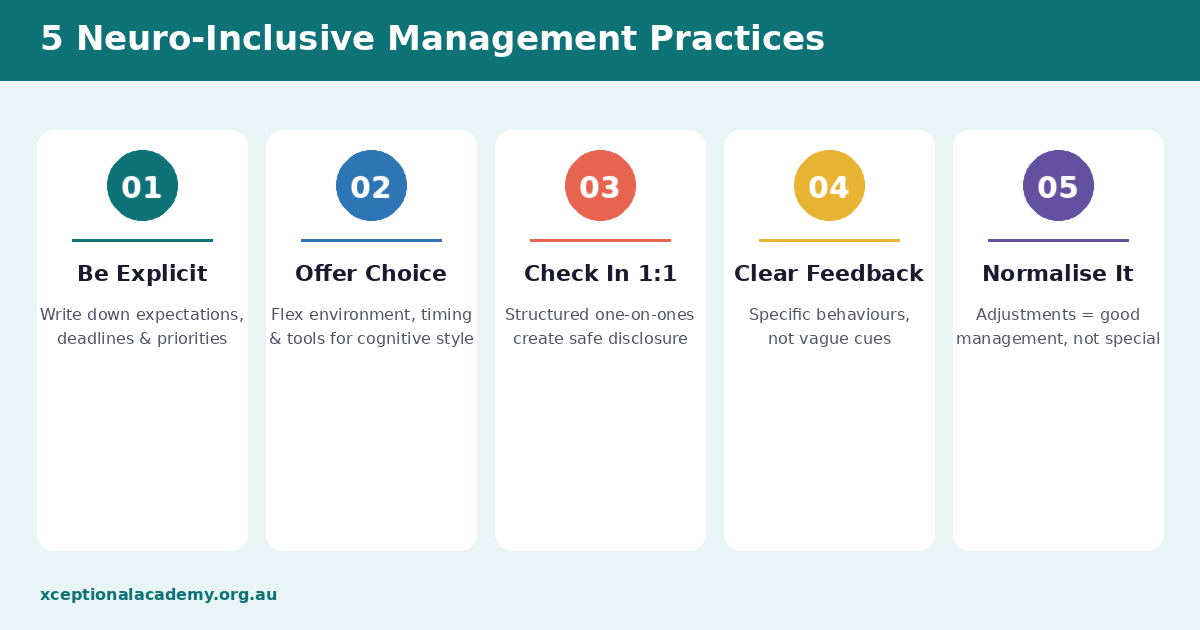
- Be explicit, not implicit. Write down expectations, deadlines, and priorities. Don’t assume context is shared. This helps neurodivergent team members — and frankly, everyone else too.
- Offer choice in how work gets done. Let people work in the environment, at the time, and with the tools that suit their cognitive style. Flexibility is the single most requested workplace adjustment by neurodivergent employees.
- Check in with individuals, not just the group. Neurodivergent team members may not speak up in group settings. Regular one-on-ones with a consistent structure create a safe space for them to flag what they need.
- Give feedback clearly and kindly. Avoid vague performance cues like “you need to be more proactive.” Instead, describe the specific behaviour you want to see. Clarity is kindness.
- Normalise adjustments. Frame workplace adjustments as standard good management, not special treatment. When adjustments are normalised, neurodivergent employees are more likely to disclose and ask for what they need.
The Business Case Is Stronger Than Ever
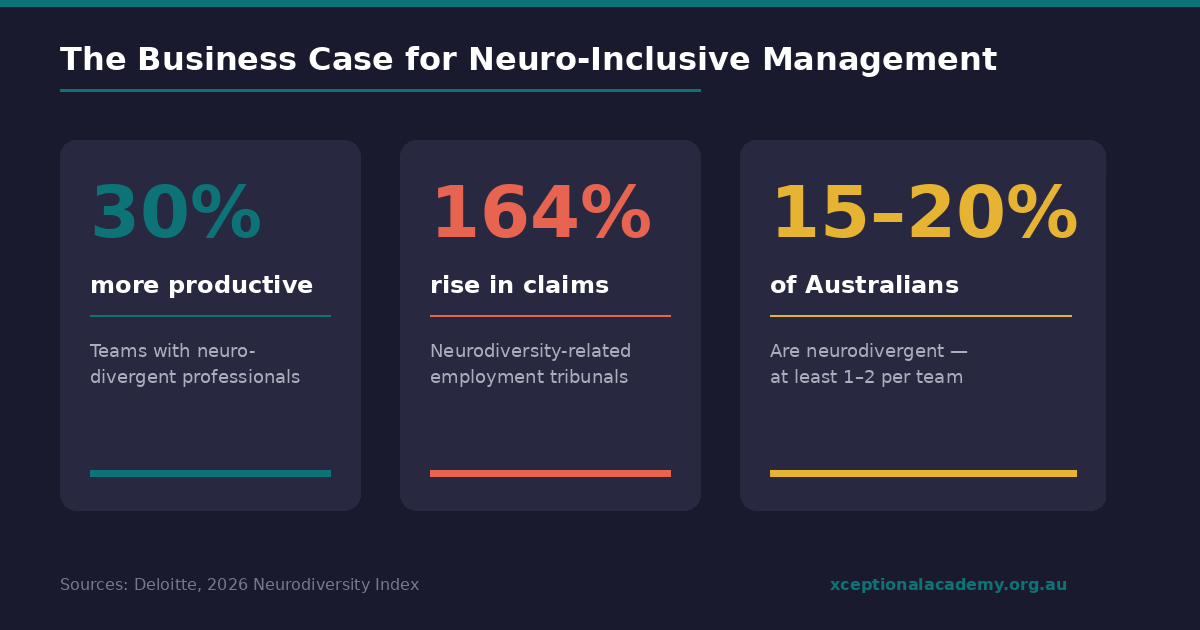
Neuro-inclusive management isn’t just the right thing to do — it’s a competitive advantage. Deloitte’s research on neuroinclusive workplaces found that teams with neurodivergent professionals in some roles can be up to 30% more productive. Meanwhile, organisations that fail to make adjustments face rising legal exposure and the quiet cost of turnover when talented people leave because they don’t feel supported.
In Australia, an estimated 20% of the population is neurodivergent. In any team of ten, the chances are at least two people are navigating the workplace with a brain that processes information differently. The question isn’t whether your managers are working with neurodivergent people. It’s whether they know how to do it well.
Where to Start
If you’re an HR leader reading this, the most impactful thing you can do right now is invest in manager capability. Not another awareness poster. Not another all-staff webinar. Targeted, practical training that gives your people managers the confidence and tools to lead neuro-inclusively.
At Xceptional Academy, our Neurodiversity Inclusion Training is designed specifically for managers and teams. It’s approved by Disability Employment Australia, built on lived experience and current research, and focused on the practical skills that close the confidence gap. Because when your managers get this right, everything downstream improves — engagement, retention, productivity, and belonging.
Your managers are already shaping the experience of neurodivergent employees every single day. The only question is whether they’re equipped to do it well.
| Ready to equip your managers?
Explore Xceptional Academy’s Neurodiversity Inclusion Training for Managers and Teams |